The problem
Many people have useful things they no longer use, and someone a few streets away often needs exactly that. But there's no simple, safe way to connect the two without sharing personal details publicly.
Once people did find the app, the same questions kept coming up: Is my address safe? Can I give food? How do I get items? And many people prefer to ask in their own language.
What I designed and built
- Separate donor and recipient flows, so each person only sees the steps that matter to them.
- 10 item categories and a simple 3-step way to give.
- Near-you search within 2–20 km, by area.
- A live map with approximate pins. Exact addresses stay private until a donor and recipient are matched.
- In-app or WhatsApp chat and a safe handover code, so the right person collects the right item.
- An installable app that works from the home screen, plus SEO blog guides to help people find it on Google.
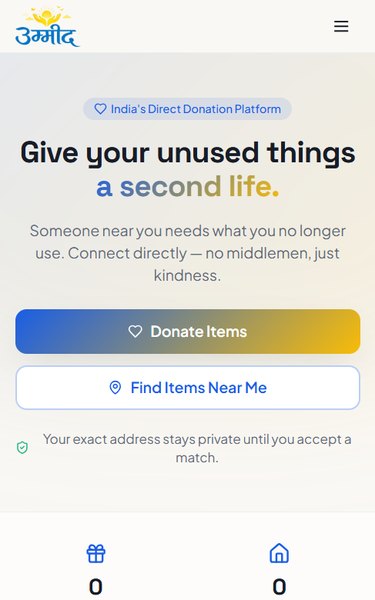 Home
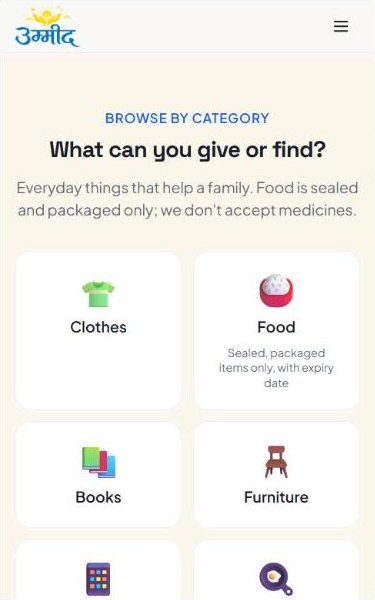 10 categories
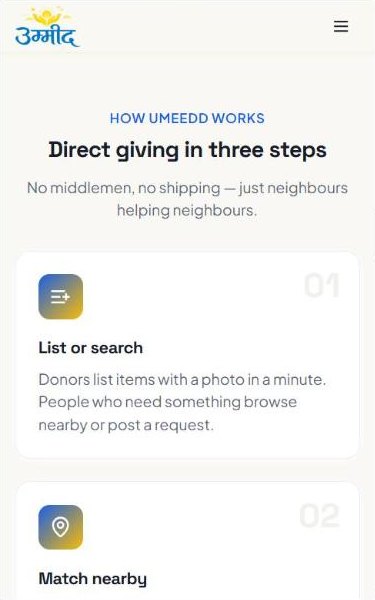 3-step giving
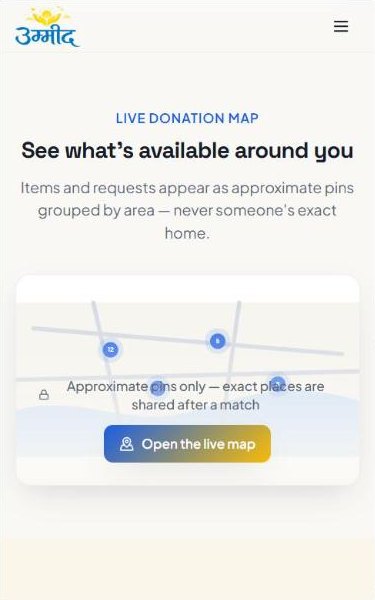 Live map
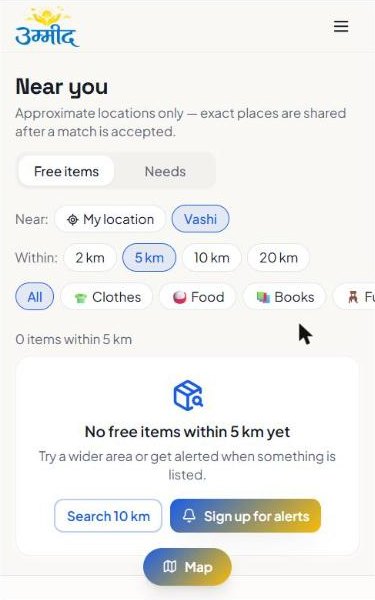 Near-you search
Privacy and safety by design
Giving things to strangers only works if people feel safe. So privacy shaped the product from the start: the map shows only approximate locations, exact addresses are shared only after a match, chat can stay inside the app, and a handover code confirms the right person is collecting.
Umeedd Sahayak: the AI assistant
Instead of an FAQ page nobody reads, I built an assistant into the app. It answers from Umeedd's real rules, not general internet knowledge, so it stays accurate about what can and can't be donated.
- Any language: it replies in whatever language people write, such as Hindi, English, Spanish and more.
- Points to the right button in the app instead of giving long explanations.
- Knows its limits: tricky cases go to a "Talk to the team" form.
- Works on Indian networks: some internet providers block common cloud services, so requests go through the app's own address and still get through.
- Built to stay up: if the AI is slow, it retries with a backup model instead of leaving people waiting.
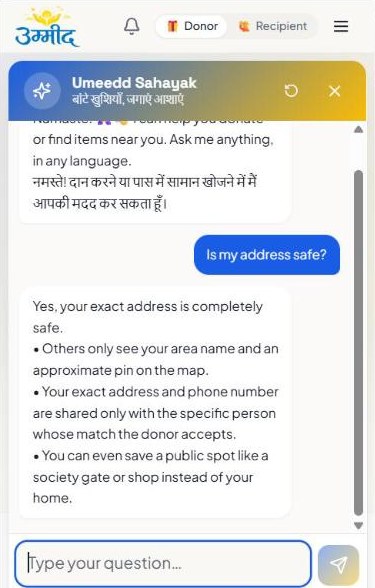 English
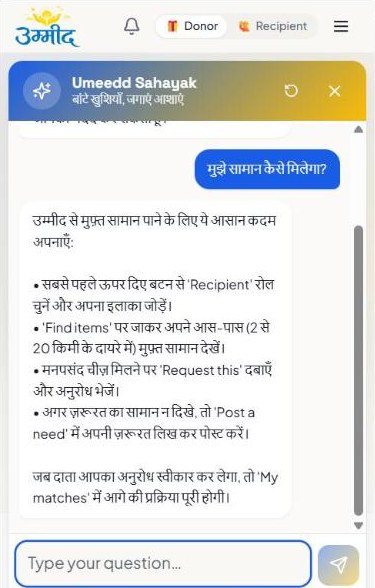 हिन्दी
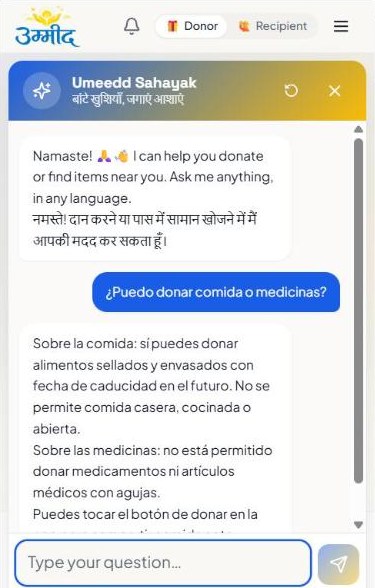 Español
How it's built
React on the front end; Supabase for the database and server functions; Google Gemini for the assistant. The app is a mobile-first, installable web app, so it works on any phone without an app store.
Have an idea like this?
Tell me about it, even a rough one. You'll get a clear plan and a fixed price before any work starts.